Last month, we mentioned that we’re celebrating 10 years of serving the accounting profession, and we shared what we believe firms need most to navigate today’s unprecedented change: a coaching culture grounded in conscious leadership. We explored how firms facing private equity, AI disruption, succession gaps, M&A activity, and talent challenges can better navigate uncertainty by investing in their leaders and creating environments where people feel connected, supported, and empowered to grow.
This month, we’re continuing that conversation by addressing some of the real-world questions firm leaders are asking us:
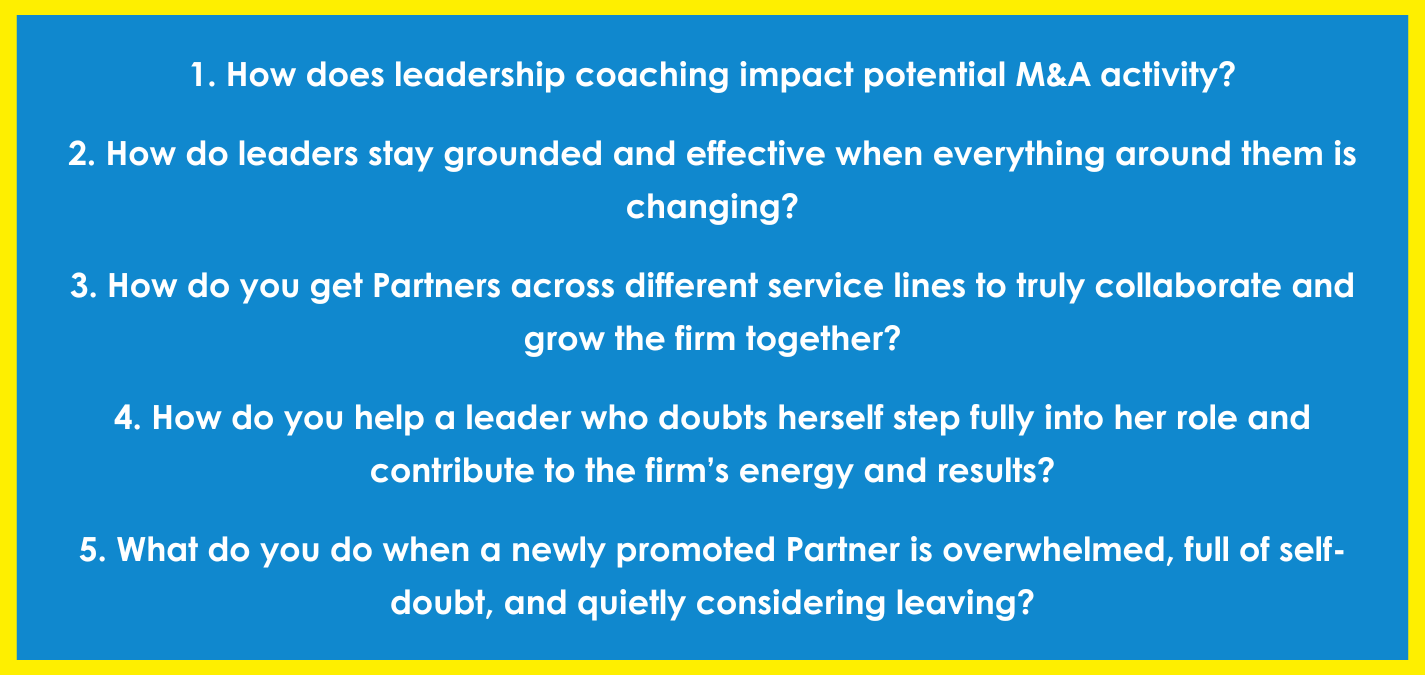
Read on for our responses to each of these questions and explore how firms are using coaching and conscious leadership to navigate today’s challenges with greater confidence, connection, and resilience.
The accounting profession is changing quickly, and the firms that will thrive are the ones willing to invest in people, relationships, and leadership development today. When leaders feel supported, connected, and equipped to navigate uncertainty, firms create coaching cultures capable of adapting, growing, and building a stronger future for the profession.
 Q: How does leadership coaching impact potential M&A activity?
 A: For one firm whose leaders we coached, it resulted in a better deal and a smoother landing.
We weren’t hired to prepare this firm for a transaction. We were hired to develop their next generation of leaders.
Over two years, we helped these leaders build a coaching mindset, develop more evolved relationships with one another, and cultivate the skills to lead through uncertainty and change.
When that firm was eventually acquired by a larger firm, their Managing Partner credited the work we had done together with making them more attractive to the acquiring firm. Further, it better equipped them to navigate the transaction and subsequent integration more smoothly than they would have otherwise.
The acquiring firm saw leaders who were actively developing, more engaged, and more mature, with a more leveraged business model, higher profitability, and lower turnover.
Coaching as a leadership style builds the kind of firm that is ready for whatever comes next.
Q: How do leaders stay grounded and effective when everything around them is changing?
A: Through coaching, and teaching coaching as a leadership style, we help leaders navigate uncertainty, find their footing, and lead through transition.
We have worked with many leaders through significant technology adoption and M&A or private equity transitions. We often hear them asking, “Where do I fit in, and how do I lead effectively when I don’t have all the answers?”
We help those leaders take a coaching approach to uncertainty and ambiguity – to ask better questions of themselves and others and uncover what is possible in their new environment rather than being driven by fear of what they might lose.
The profession is navigating more of these transitions than ever before, and the leaders who have developed the capacity to lead through the unknown will be the most successful.
Q: How do you get Partners across different service lines to truly collaborate and grow the firm together?
A: You help them build connection and trust through group coaching.
In accounting firms, siloing is common and specialization runs deep. Investing in the relationships between Partners changes more than most firms expect.
Through many year-long development programs, we have brought together groups of new Partners, some of whom had merged in from other firms.
When we started, they didn’t know each other well, didn’t fully understand each other’s lines of service, and weren’t bringing each other into opportunities.
Through the program, they built more evolved relationships with one another by practicing empathy and vulnerability in group coaching. They developed trust across service lines and began to understand what the rest of their firm could do for their clients.
When you increase trust amongst Partners, you increase the firm’s ability to serve clients, grow revenue, and cross-sell.
Partners are more willing to let go and transition clients to others within the firm when they have deeper, more collaborative relationships.
Q: How do you help a leader who doubts herself step fully into her role and contribute to the firm’s energy and results?
A: Invest in coaching to help her find her voice, show up authentically, and actively contribute to the firm’s energy and results in ways that make the firm better.
We have worked with a number of women recently promoted to executive leadership positions at their firms who were struggling with confidence, worried to speak up, and uncertain how to navigate an environment where they were one of the few or only women in the room.
They wanted to be themselves and bring what they uniquely had to offer, and they needed support to do that with confidence.
Through coaching, we’ve seen these leaders find their voices, show up authentically, and actively contribute to the firm’s energy and results.
When these leaders feel confident showing up and contributing in their unique way, the male leaders are able to learn from them, and the firm is better for it.
Q: What do you do when a newly promoted Partner is overwhelmed, full of self-doubt, and quietly considering leaving?
A: Invest in executive coaching to give them the space to explore what they actually want. More often than not, they choose to stay and thrive.
Making Partner is one of the most significant achievements in an accountant’s career, but what actually happens during this transition is something the profession doesn’t talk about enough.
We have worked with dozens of newly promoted Partners who arrived at a role they spent years building toward, only to find themselves overwhelmed, full of self-doubt, and questioning whether they were a fit for the firm.
Some contemplated leaving.
Through coaching, we gave those leaders the space to explore what they actually wanted, to craft a vision of what success could look like for them, and to ask for the support they needed.
Over time, we have seen many of these leaders double down as Partners and contribute in ways that exceeded their own and the firm’s expectations.
When people are really struggling, they don’t usually show it. However, when you give them the support to navigate this struggle, it can make all the difference between staying or leaving.
See you in the DOP,